
One of the most critical technological solutions for modern organizations is AI cybersecurity. Phishing efforts, ransomware, credential theft, data breaches, insider threats, and automated attacks are all becoming more complex, requiring smarter automated defenses.
Security teams are also expected to recognize and address risks more quickly than in the past.
Artificial intelligence is becoming more and more significant in this regard.
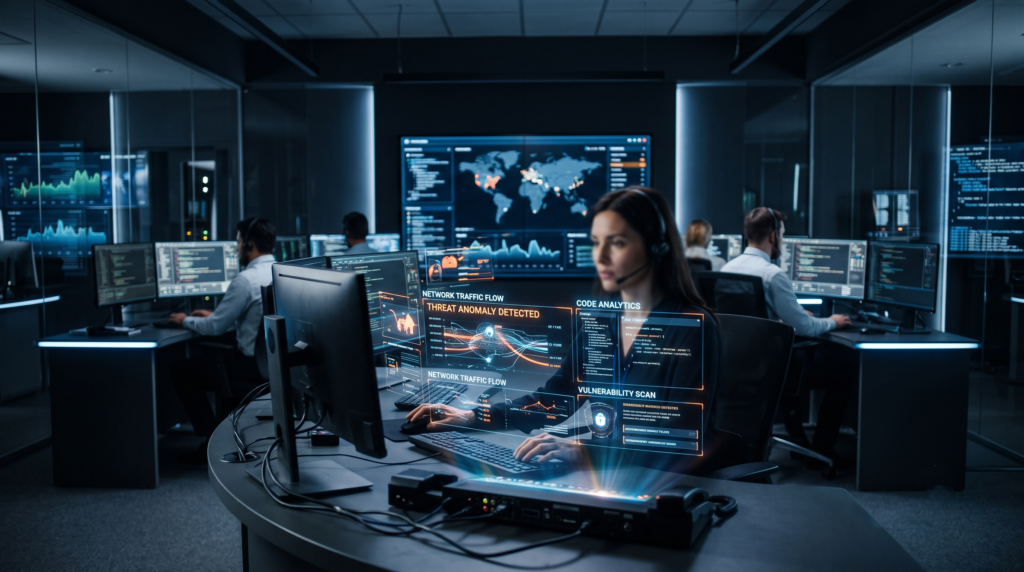
AI is starting to be used in modern security operations centers to analyze massive volumes of security data, spot anomalous behavior, rank possible dangers, and assist security analysts in responding to incidents more quickly.
The necessity for cybersecurity experts is not eliminated by AI. Rather, it can speed up information processing and allow security teams to concentrate on dangers that call for human judgment.
1. What Is AI Cybersecurity and How Does It Work?
AI in cybersecurity refers to the application of machine learning and artificial intelligence technology to detect, evaluate, and address any security risks.
Conventional security solutions frequently rely significantly on pre-established guidelines and signatures. A security program could identify a known dangerous file, for instance, based on a pattern that has already been found.
That strategy is still effective, although contemporary attacks can evolve rapidly.
In order to evade conventional detection systems, attackers might alter malware, craft convincing phishing messages, hack trustworthy accounts, and employ automated methods.
AI-based security systems are able to recognize activities that could seem out of the ordinary by analyzing patterns in vast volumes of data.
Depending on the system, this may consist of:
- Strange behavior upon logging in
- Unusual network activity
- Unusual user behavior
- Possible malicious activity
- Multiple unsuccessful attempts at authentication
- Unusual access to private information
- Untrustworthy email action
- Unexpected modifications to cloud environments
- Possible compromising of credentials
Gathering additional security data is not the only objective. Converting massive amounts of data into valuable security intelligence is the aim.
2. Why Traditional Cybersecurity Monitoring Is Becoming More Difficult
Thousands of devices, apps, cloud services, and user accounts may be present in a contemporary organization.
Security events can be produced by any of these systems.
As a result, a large company setting may generate massive amounts of data every day.
Every alarm cannot be manually investigated by security professionals.
Alert fatigue is a serious issue that results from this.
It becomes challenging for security personnel to identify which occurrences constitute real dangers when they get hundreds or thousands of notifications.
Certain warnings could be innocuous activities. Others would point to a major assault.
AI may assist by analyzing various signals and determining connections between occurrences.
For instance, a single unsuccessful login attempt might not be that alarming.
But suppose the same account:
- has several unsuccessful attempts to log in.
- successfully logs in from a strange place.
- has access to a critical program.
- downloads a lot of information.
- attempts to get into other internal systems.
These occurrences do not always indicate an assault on their own.
When taken as a whole, they can indicate a potentially dangerous security event.
These signals can be connected and brought to analysts’ notice by AI-assisted security solutions.
3. The Role of AI in a Security Operations Center
Monitoring and reacting to cybersecurity threats is the responsibility of a Security Operations Center, or SOC.
Information may be obtained by a contemporary SOC from a variety of sources, such as:
- Firewalls
- Systems for endpoint security
- Cloud-based systems
- Identity providers
- Systems for email security
- Tools for network monitoring
- Logs of applications
- Systems for authentication
- Platforms for event management and security information
- Scanners for vulnerabilities
Converting all of this data into useful intelligence is the difficult part.
AI can help with this process in a number of ways.
3.1. Identification of Threats
Network traffic patterns, authentication activity, endpoint behavior, and other security signals may all be analyzed by AI.
Machine-learning models can assist in identifying behavior that seems out of the ordinary rather than depending solely on established signs.
When organizations are confronted with novel or quickly evolving assault strategies, this can be very helpful.
3.2. Prioritization of Alerts
Not all security alerts require the same amount of attention.
Security platforms can employ AI to evaluate warnings based on variables including potential severity, impacted systems, user behavior, and past activity.
This can assist analysts in concentrating on the events that might provide the biggest danger.
3.3. User Behavior Analysis
Analytics on user behavior can spot behavior that deviates from a known trend.
For example, an employee who regularly accesses a modest number of programs during business hours can suddenly seek to access crucial systems late at nite.
That does not imply that the account has been hacked.
It could, however, warrant more research.
Security teams can find these behavioral abnormalities at scale with the use of AI.
3.4. Malware Identification
Malware detection can also be aided by AI and machine-learning methods.
Conventional antivirus software uses signatures and other clues to recognize known harmful files.
In order to detect potentially harmful activities, contemporary security solutions may also analyze file behavior and other features.
This can give another layer of defense against changing threats.
3.5. Automated Investigation of Incidents
Analysts may need to review logs, authentication records, endpoint data, and network activity in order to investigate an event.
AI-assisted techniques can assist in summarizing this data and highlighting evidence that may be pertinent.
An analyst could get a better organized summary of what transpired and which systems might have been impacted rather than having to manually go through thousands of events.
Before making significant decisions, human analysts should nevertheless verify significant discoveries.
4. AI Can Help Reduce Security Analyst Workload
Automation is one of the main benefits of AI cybersecurity technology.
Security analysts spend substantial time doing repetitive activities.
These can include:
- Reviewing alerts
- Searching logs
- Gathering incident information
- Checking IP addresses and domains
- Comparing security incidents
- Summarizing incidents
- Investigating repeated alerts
- Documenting occurrences
Automation can do some of these chores significantly faster.
An AI-assisted system may, for instance, gather pertinent events from several security platforms and produce a preliminary incident report for an analyst.
The analyst can then spend more time considering what action should be taken.
This does not imply that people are no longer needed.
Business context, legal issues, operational risk, and uncertainty may all play a role in cybersecurity choices.
Human knowledge is still crucial.
5. AI Is Also Creating New Cybersecurity Risks
Defenders are not the only ones using AI.
Attackers can utilize AI as well.
As a result, the security environment becomes more complicated.
AI-assisted technology may be used by attackers to produce convincing phishing messages, automate reconnaissance, analyze data, and even increase the scope of their activities.
This implies that businesses must take into account both aspects of AI security.
The query is no longer just:
“How can AI be used to enhance cybersecurity?”
Additionally, it is:
“How can we defend our company from AI-based threats?”
6. AI-Powered Phishing and Social Engineering
One of the most popular methods used by attackers to try to access accounts and systems is still phishing.
AI can make harmful communications more persuasive by helping attackers develop polished and personalized material.
As a result, conventional warning indicators like misspellings or glaring grammatical errors may become less trustworthy.
Instead of depending just on users identifying questionable language, businesses require more robust identity protection, staff knowledge, email security, and authentication restrictions.
An organization’s security posture may be greatly strengthened by multi-factor authentication, robust identity management, and phishing-resistant authentication solutions.
7. AI and Cloud Security
Cloud computing has transformed how businesses create and manage apps.
Public cloud services, SaaS apps, containers, APIs, and conventional infrastructure may now all be used by businesses.
This generates yet another substantial source of security information.
AI can assist in analyzing cloud activities and spotting odd behavior.
For instance, a security system may keep an eye on:
- Unexpected modifications to cloud resources
- Unusual activities using APIs
- Untrustworthy administrative acts
- Unusual patterns of authentication
- Unexpected transfers of data
- Incorrectly set permissions
- Unusual access to critical services
Because a hacked account might occasionally provide an attacker access to several computers, cloud security is very crucial.
8. The Importance of Identity Security
Passwords are no longer enough to secure contemporary digital settings.
One of the most crucial aspects of cybersecurity nowadays is identity.
Attackers routinely seek to breach user accounts because authentic credentials can allow them to bypass certain traditional security safeguards.
Therefore, organizations should combine robust identity restrictions with AI-assisted surveillance.
Important metrics include:
- Multiple-factor verification
- Strong password policies
- Single sign-on
- Conditional access
- Management of privileged access
- Least-privilege permissions
- Frequent evaluations of access
- Monitoring of unexpected authentication activities
Strong security architecture is still the cornerstone, but AI may assist in spotting questionable activity.
10. AI Cybersecurity in the US and UK
Organizations have different objectives when it comes to cybersecurity, but companies in the US and the UK are increasingly concentrating on resilience, data protection, identity security, and incident response.
Depending on the business, cybersecurity plans for US organizations may need to take into account federal security regulations, state privacy legislation, and sector-specific needs.
UK organizations also need to assess the security regulations applicable to their industry and their duties surrounding personal data and operational resilience.
Therefore, rather than using a one-size-fits-all approach, cybersecurity policies for companies operating overseas should be created around the organization’s particular regulatory and operational context.
This is especially crucial for businesses that handle client data internationally.
11. Can AI Replace Cybersecurity Professionals?
The need for cybersecurity experts is unlikely to be eliminated by AI.
Rather, security experts’ roles are probably going to shift.
Security analysts should spend more time on the following tasks and less time manually going through repetitious alerts:
- Hunting for threats
- Reaction to an incident
- Architecture for security
- Risk management
- Engineering for detection
- Strategy for security
- Governance of AI
- Examining intricate attacks
The most effective security teams will probably blend human knowledge with automation.
AI is capable of processing data rapidly.
Humans are able to offer accountability, context, and judgment.
When there are significant security events, that combination is very crucial.
12. Challenges of Using AI for Cybersecurity
AI cybersecurity technology has limits despite its potential.
12.1. False Positive Results
Sometimes, normal activities might be flagged as suspect by AI systems.
Despite automation, alert fatigue may persist if security personnel receive an excessive number of erroneous notifications.
12.2. False Negative Results
No detection system is flawless.
A smart assault could go undetected or look like normal activity.
Thus, AI ought to be seen as a part of a more comprehensive security plan.
12.3. Quality of Data
AI systems depend largely on the quality of the information they analyze.
Incomplete logs, wrong setups or inadequate historical data might impair the utility of security models.
12.4. Confidentiality
Businesses must carefully evaluate the data that AI systems process.
Sensitive data regarding users, clients, and company activities may be found in security logs.
Thus, data management, access restrictions, and suitable governance are crucial
12.5. Explainability
Security teams might need to know why an event was deemed suspicious by a system.
When crucial commercial or security choices are at stake, it can be challenging to trust black-box suggestions.
For high-impact acts, organizations should retain proper human oversight.
13. What a Modern AI-Enabled SOC Could Look Like
Several technologies can be integrated into a single security process by a contemporary Security Operations Center.
This is how a typical procedure may appear:
Data gathering → detection → AI analysis → risk assessment → analyst research → reaction → ongoing education
Security events are gathered from many systems.
Potentially questionable behavior is identified by detection technology.
AI helps prioritize the event by analyzing the context that is provided.
The event is looked at by a security analyst.
When necessary, authorized actions can then be carried out by automated response systems.
Lastly, the company may use the incident’s information to enhance detection and reaction in the future.
This starts a cycle of ongoing security enhancement.
16. How Businesses Can Start Using AI in Cybersecurity
Businesses may start utilizing AI without having to completely overhaul their security architecture.
Finding locations where security professionals already spend a lot of time is a sensible strategy.
An organization could begin, for instance, with:
- Prioritizing alerts
- Analysis of security logs
- Summary of the incident
- Analysis of threat intelligence
- Monitoring user behavior
- Automated workflows for investigations
After that, the company may assess if the technology speeds up investigations and enhances detection quality.
Clear controls over automated operations should be established by security personnel.
For instance, immediately deleting a crucial production account might have serious operational repercussions, yet automatically blocking a suspect IP address can be quite low risk in some contexts.
Thus, automation should be used based on risk.
17. What Businesses Should Look for in AI Security Tools
Organizations should consider more than just marketing promises when assessing AI cybersecurity technology.
Important queries consist of:
- What security data can the platform analyze?
- How does it work with the security technologies that are already in place?
- Can analysts comprehend the reason for the generation of an alert?
- How are false positives dealt with?
- Does the platform allow for human approval?
- What information is transmitted to outside AI services?
- How is consumer information safeguarded?
- Does the vendor give audit logs?
- Are automated acts within the authority of administrators?
- What is the system’s performance in comparison to the real environment of the organization?
Instead of depending just on product presentations, security teams should evaluate solutions using actual scenarios.
18. The Future of AI and Cybersecurity
The connection between cybersecurity and AI is probably going to grow in significance.
Security teams will continue to deal with ever-increasing data volumes and increasingly complex threats.
Attackers will also have access to more sophisticated automation at the same time.
This fosters an atmosphere where quickness is crucial.
During an event, the capacity to recognize suspicious conduct, comprehend its context, and react correctly may make a big difference.
AI shouldn’t be seen as a substitute for essential cybersecurity procedures, though.
It is still crucial to have strong identity controls, secure application development, network segmentation, frequent patching, backups, staff training, vulnerability monitoring, and incident response preparation.
AI can improve the intelligence and effectiveness of these security activities, but it cannot make up for a security architecture that is inherently flawed.
19. Final Thoughts
AI is altering how businesses handle cybersecurity.
AI can assist security teams in handling the massive amount of data produced by contemporary digital environments, from threat detection and alert prioritization to incident investigation and security automation.
Treating AI as a magic bullet is not the best course of action.
Organizations should instead integrate AI-powered security solutions with skilled personnel, robust identity protection, well-thought-out security rules, and well-defined incident-response procedures.
As digital infrastructure continues to grow, this combination will become more crucial for companies in the US, UK, and other significant technological markets.
It seems doubtful that cybersecurity will be fully automated or fully human in the future.
Intelligent technology and seasoned security experts will collaborate, each doing what they do best.